Today was my beautiful neice Hannah's first one, and what fun she had! Some photos in the albums...
 |
| Hannah's Bithday |
|
| Hannah's Bithday |
 |
| Acapulco |
In pre-Hispanic Mexico , in the valley where Mexico City stands was a lake called Lago Texcoco, which now has long been drained. The Aztecs, long before the Spanish came, dug a series of canals around the edge of the lake, and the mud they dug was heaped on the earth around the canals or on anchored reeds atop the water. These plots of land, appeared like floating islands called chinampas - hence, their name ‘floating gardens’.
To maintain soil fertility, farmers annually scraped muck from the canal bottom and applied decaying aquatic vegetation to the islands to prepare seed beds. The gardens became one of the most productive farming systems ever developed. By the time the Conquistadors came, the area of Xochimilco had become a rich agricultural district where many of the city's flowers, fruits and vegetables were grown.The Aztecs built their capital city, called Tenochtitlan, in the center of enormous Lake Texcoco. The Aztecs believed they were the “chosen people” of Huitzilopochtli and did everything that he desired of them. During the fourteenth century, Huitzilopochtli told the Aztec chieftain that their new homeland would be on the island in Lake Toxcoco, and when they reached the island they were to look for an eagle eating a snake perched on a cactus growing from a rock or cave surrounded by water. This would be the location where they were to build their city and honor him. They found this location and began to build their city around the year 1325 AD.
The city of Tenochtitlan continued to grow, having an estimated population of 200,000. The city grew to a point where there was no more room for expansion on the island and they were forced to move out into the lake areas. The agricultural portion of this expansion was successful because of the invention of the chinampas or floating gardens. The floating gardens were constructed by bunching twigs together then stacking mud on top of the twigs. They were not anchored at first and could be towed until the plants roots anchored into the lake floor.
The Aztecs connected the island to the mainland by three causeways that ran next to dikes that were built to keep the fresh water of Lake Texcoco separate from other salty lakes of the area. The dikes also protected the agricultural chinampas. Canals ran between the chinampas; they were used to convey traffic through the city, including to and from the market of Tlatelolco.
The city flourished until the year 1521 when Hernandez Cortes and his Spanish army invaded and captured the city. The Spanish also had two other advantages: a lot of tactical skills on behalf of Cortes and smallpox, which devastated the Aztec population. After he defeated the Aztecs, Cortes destroyed most of the buildings that they had built and constructed the new Spanish city on top of the ruins, even using many of the original Aztec building materials in the new construction. He built his home on top of Montezuma’s palace and his cathedral on top of the Aztec temple. After a battle in 1692 the Spanish destroyed most of the art of the Aztecs in the name of Christianity. More info from Wikipedia here.
 At the mouth of the Dardanelles lies the town of Eceabat. The car ferry to Canakkale (and Troy) leaves from here, and we came back to here to go to the Gallipoli Battlefields. The fort below is Kilitbahir Castle. The name Kilitbahir can be translated as 'lock to the sea'. The castle was built by Sultan Mehmet the Conqueror in 1452 to control the straits and secure Istanbul. In later years, the castle was extended, with towers and gun placements being added.
 In 1551, Sultan Suleyman repaired the castle, which has a seven-storey keep in the form of a clover leaf in its centre.
 With our Turkish guide, we boarded the bus for the Gallipoli Peninsula. The mood was quite sombre, and we listened to the guide talk about the sacredness of the site - for Australians and New Zealanders, and for Turks as well.


 Many an Anzac was introduced to war as he moved up these valleys to the ridge. For virtually the whole of the campaign, but especially in the early weeks, further up Shrapnel Valley where it turned to the right and became Monash Valley, Turkish snipers killed or wounded hundreds of men. The Turks held the high ground at places like Dead Man’s Ridge and the Bloody Angle and were never driven from it. Stretcher-bearers, and soldiers bringing up supplies, rations and water, were in constant danger as they made their way along the valley bottom. This sniping was at its worst during the early hours of daylight when the sun was behind the Turkish marksmen. It was while doing his duty in Monash and Shrapnel valleys on 19 May 1915 that the best known Anzac of all – John Simpson - ‘The Man with the Donkey – met his death.
 Some 27,000 Australian, New Zealand, British and Indian troops were put ashore in Anzac Cove between 25 April and 1 May 1915. While the great majority of these troops were Australians and New Zealanders there were also units that aren't usually taught to us as part of the legend - the Ceylon Planter’s Rifle Corps, the Indian Mule Cart Transport, the Zion Mule Corps, the 7th Indian Mountain Artillery and about 2,500 men of the British Royal Naval Division, Chatham, Portsmouth, Nelson and Deal Battalions. All of these units fought alongside the Anzacs.

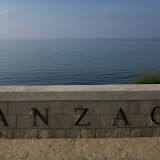
 And so we arrived at Anzac Cove. Looking down from the road onto the beach, the thoughts in my head were all about what on earth was going through those young men's minds as they landed in this inhospitable place. For those that landed, it was an absolute nightmare, and of course we know how many didn't even land. This poem was written by soldier-poet Leon Gellert, who landed on April 25th, 1915 and was evacuated in July with dysentery.
Anzac Cove
There’s a lonely stretch of hillocks
There’s a beach asleep and drear
There’s a battered broken fort beside the sea.
There are sunken trampled graves
And a little rotting pier
And winding paths that wind unceasingly.There’s a torn and silent valley;
There’s a tiny rivulet
With some blood upon the stones beside its mouth.
There are lines of buried bones
There’s an unpaid waiting debt
There’s a sound of gentle sobbing in the south.

The success of the Turks at Gelibolu was (very simply and in a few words) the result of the poor planning and arrogance of the Allies, and the inspirational leadership of the Turks by Mustafa Kemal. For the first time, Turks were fighting for their homeland. During the Battle of the Landing, Kemal has been credited with one of the most famous orders issued to Turkish troops during the whole campaign – ‘I don’t order you to attack, I order you to die. In the time which passes until we die other troops and commanders can take our place’. After the war, Kemal went on to be become the first President of the Turkish Republic in October 1923. He became known as Atatürk, meaning father ofTurks, for his modernisation of the country after centuries of Ottoman rule.
more photos at http://picasaweb.google.com.au/sue.thomson/Gallipoli


 Today we decided to explore some of the sites we hadn't been to on our grand tour!


 Then continuing on until we did reach the market, where we had some intensive retail therapy (again!), and recovered with PROPER coffee!!!


 that you sit on to begin the 'cooking'. This is the room, but there were around 20 naked women in there having a bath, plus similarly naked attendants. It was quite crowded and very busy! Every now and then, the women attendants would start singing, which added to the enjoyment of all concerned I think.
 Today, with the PISA meeting all wrapped up, the Turkish Ministry of Education turned on the grand tour of Istanbul for us. With the weather overcast and cold, we set off in buses early so as to avoid the papal entourage again. And what a day they had planned for us!
 The Byzantine emporer Theodosius had it brought to Constantinople in 390AD, and erected on a marble pedestal engraved with scenes of his own life and times.
 Next stop was the famous Blue Mosque. This was built by Sultan Ahmet in the 1600s, and it was built to surpass the beauty of the nearby Aya Sophia. It is the only mosque outside Mecca to have 6 minarets, and the courtyard is the biggest of all the Ottoman mosques. Inside there are tens of thousands of blue tiles, hence it's name, and more than 250 windows.

 It was constructed on Byzantium's acrpolis, which had been the site of two earlier churches, one built by Constantine's son in 360 and another built by Theodosius in 415 and destroyed in riots in 532. This one's clearly doing better! The Byzantine emporers were crowned here. It was the the greatest church in Christendom until the conquest of Constantinople in 1453, when Mehmet the Conqueror took posession of it for Islam and converted it into a mosque.


 This place is absolutely enormous, and I'm sure the short time we spent there barely scratched the surface of what the palace as to offer as a museum. Inside the grounds is a church built in about 540, which replaces a christian church and before that a pagan temple. One one side is a little fountain where the imperial executioner washed his tools after beheadings; the heads were then displayed on pikes above the gate.


 The Topkapi treasury holds a fantastic collection. There is the sword of Suleyman the Magnificent, the throne of Ahmed I, and the arm and skull of John the Baptist, which were in the hands of the Byzantines and fell to the Ottomans with the Conquest. The Topkapi dagger is stunning. There are three huge emeralds set into the hilt and a watch in the pommel!


 Ok, we were pretty much all palaced out by now, so back onto the bus we went, ostensibly for home. No, there was one last stop... something special ... planned just for us.. oh god, I thought, it's going to be bloody carpets!!! No, wrong, it was a special leather show, for which the tour guide no doubt got a cut. Some of us boycotted this and went next door for a very good cup of coffee. We then organised the buses before the guide came back out - one to go directly back to the hotel and the other for those not totaly knackered who wanted to put themselves back into the hands of the tour guide. We found out later that night that this group went to a rug outlet... buhahahahaha!!!!